
Sales Tech Stack: Building Systems That Actually Work
Learn how to build a sales tech stack that drives results. Discover essential tools, integration strategies, and how AI transforms B2B sales.
published
The modern B2B sales environment demands more than spreadsheets and good intentions. Sales teams today operate within complex ecosystems of software, data, and automation designed to accelerate revenue generation. Yet many organizations find themselves drowning in disconnected tools that create more friction than value. A well-designed sales tech stack serves as the foundation for predictable growth, but building one requires strategic thinking about what actually moves the needle versus what simply adds complexity. The difference between a high-performing sales organization and one struggling to hit quota often comes down to how thoughtfully they've assembled and integrated their technology infrastructure.
Understanding the Core Components of a Sales Tech Stack
Every effective sales tech stack begins with fundamental building blocks that support the entire revenue generation process. These components work together to create a seamless flow from initial prospect identification through deal closure and customer retention.
Customer Relationship Management Platform
The CRM serves as the central nervous system of your sales tech stack. This platform houses customer data, tracks interactions, manages pipeline progression, and provides visibility into deal status across your entire organization. Without a robust CRM, sales teams operate in silos, losing valuable context and creating duplicated effort.
Key capabilities every CRM must deliver include:
Contact and account management with complete interaction history
Deal pipeline visualization and forecasting tools
Activity tracking and task management
Reporting and analytics dashboards
Mobile access for field sales teams
Modern CRM platforms have evolved beyond simple contact databases. They now incorporate predictive analytics, workflow automation, and integration capabilities that connect with dozens of other tools. Salesforce outlines how CRM platforms anchor the entire technology ecosystem, serving as the single source of truth for customer information.
Prospecting and Lead Generation Tools
Finding and qualifying potential customers requires specialized technology designed to identify ideal prospects and gather actionable intelligence. These tools complement your CRM by feeding it with fresh, qualified opportunities.
Tool Category | Primary Function | Key Benefit |
|---|---|---|
Lead databases | Access to contact information | Faster list building |
Intent data platforms | Identify buying signals | Better timing |
Email finders | Locate decision-maker contacts | Higher connection rates |
Social selling tools | Engage prospects on LinkedIn | Relationship building |
The prospecting layer of your sales tech stack determines the quality of opportunities entering your pipeline. Investing in accurate data sources and intent signals pays dividends throughout the sales cycle by ensuring reps spend time on genuinely interested prospects rather than cold contacts.
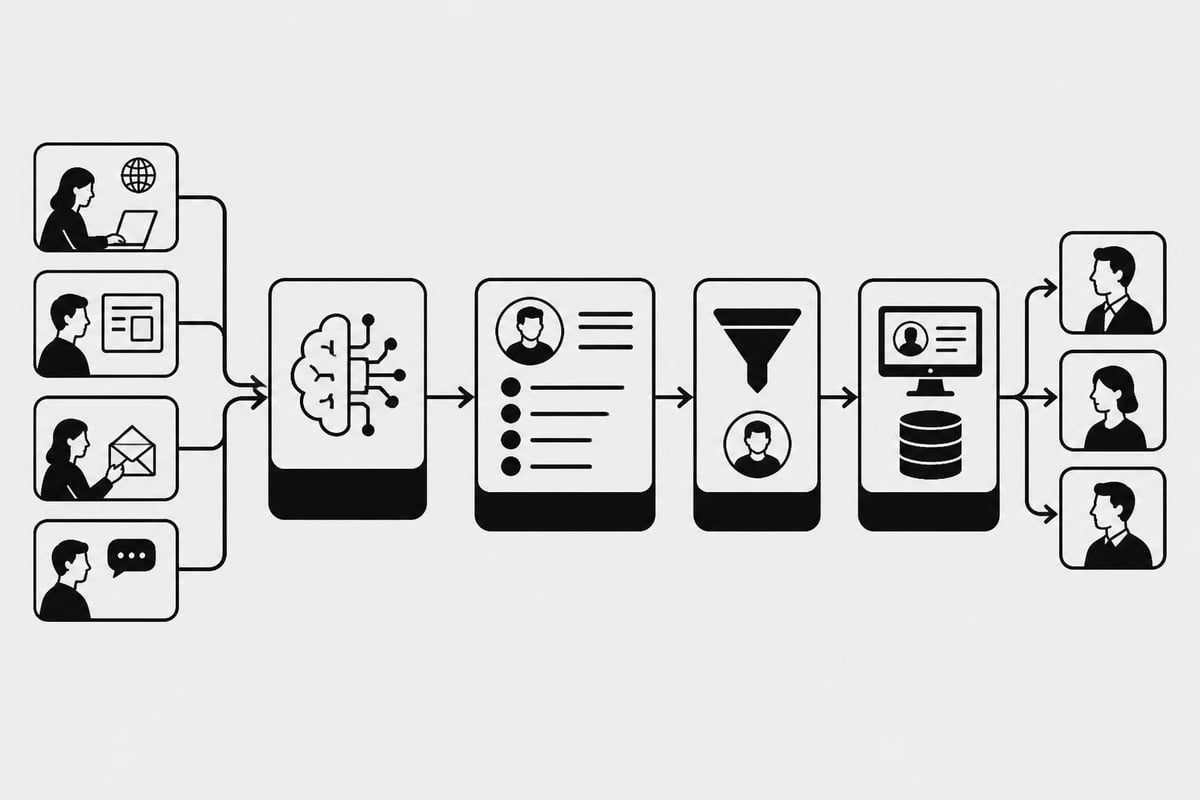
Sales Engagement and Automation Platforms
Sales engagement tools enable reps to execute multi-touch campaigns at scale while maintaining personalization. These platforms orchestrate email sequences, call tasks, social touches, and follow-ups based on prospect behavior and response patterns.
The distinction between helpful automation and spam lies in strategic implementation. Effective engagement platforms track what resonates with different prospect segments, allowing continuous refinement of messaging and timing. They also prevent the awkward scenario where multiple reps contact the same prospect with conflicting information.
Building Your Sales Tech Stack Strategy
Assembling technology without a clear strategy creates expensive chaos. The most effective approach starts with understanding your sales process, identifying specific friction points, and selecting tools that directly address those challenges.
Mapping Technology to Sales Process Stages
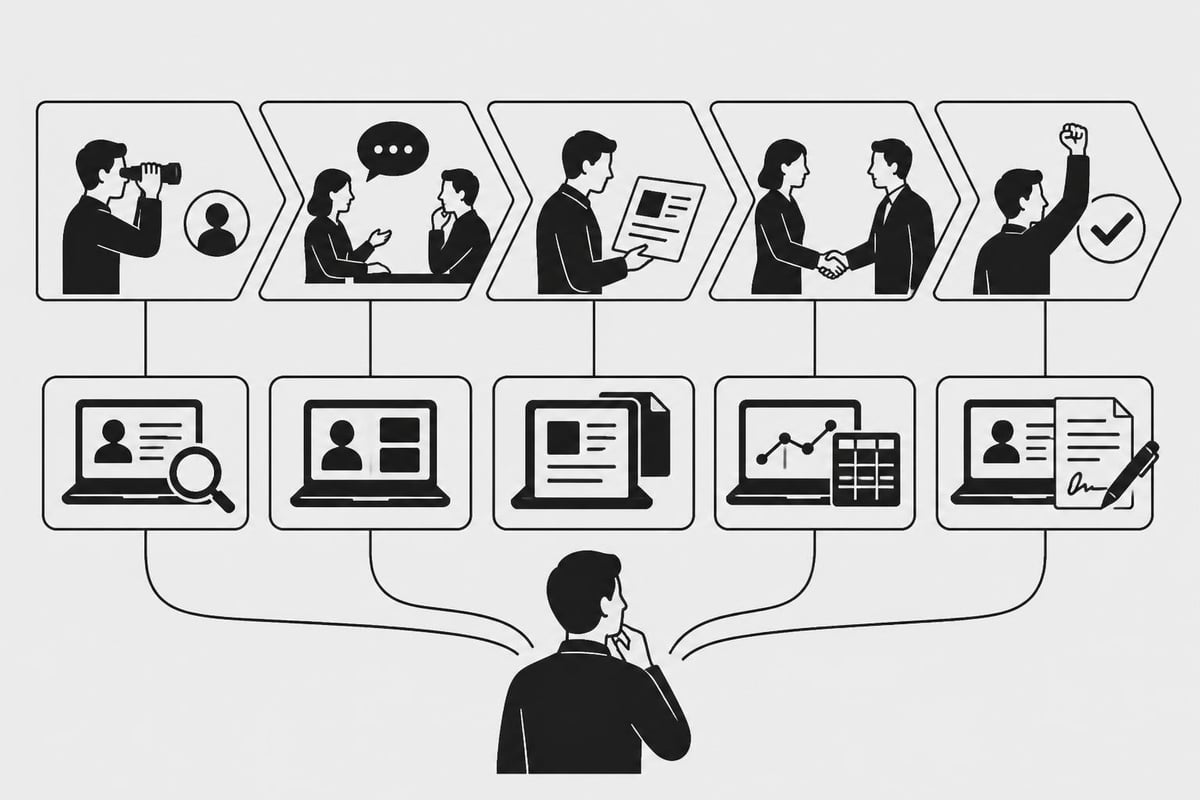
Your sales methodology should dictate your technology choices, not the other way around. Begin by documenting each stage of your sales process from initial outreach through deal closure. For each stage, identify the primary activities, common bottlenecks, and information requirements.
Stage-specific technology considerations include:
Prospecting stage: Data quality, list building speed, contact enrichment
Initial outreach: Email deliverability, call connection rates, response tracking
Discovery and qualification: Meeting scheduling, note-taking, qualification frameworks
Proposal and negotiation: Document generation, e-signature, approval workflows
Closing: Contract management, revenue recognition, handoff to customer success
Many sales organizations discover that building an AI-powered tech stack requires rethinking traditional process stages entirely. AI capabilities can collapse previously manual qualification steps or surface insights that fundamentally change how reps prioritize their time.
Prioritizing Integration Over Individual Features
The most powerful sales tech stack isn't necessarily the one with the most sophisticated individual tools. Integration capabilities often matter more than feature lists because disconnected systems create data silos and manual work.
When evaluating new tools, ask critical questions about data flow:
How does information from this tool sync with our CRM?
Will reps need to manually update multiple systems?
Can we trigger actions in one tool based on events in another?
Where will the definitive version of customer data live?
Native integrations through APIs provide the most reliable data synchronization. Third-party integration platforms like Zapier or Make can bridge gaps, but they introduce additional complexity and potential failure points. The ideal scenario involves tools built to work together from the ground up.
Common Sales Tech Stack Mistakes That Kill Productivity
Even experienced sales leaders fall into predictable traps when building their technology infrastructure. Understanding these pitfalls helps you avoid costly mistakes and wasted implementation time.
Tool Sprawl and Overlapping Functionality
The average sales tech stack contains 10-12 distinct tools, with enterprise organizations often running 20 or more platforms. This proliferation creates several problems:
Challenges created by excessive tools:
Reps spend more time managing software than selling
Training requirements multiply with each new platform
License costs accumulate without proportional return
Data becomes fragmented across multiple systems
Integration maintenance becomes a full-time job
If you're examining how to audit your sales tech stack effectively, start by identifying overlapping capabilities. Many organizations discover they're paying for the same functionality three times across different platforms.
Implementing Tools Without Process Alignment
Technology amplifies your existing sales process. If that process contains inefficiencies or unclear handoffs, automation simply executes bad processes faster. Before adding new tools, ensure your fundamental sales methodology is sound.
Consider a common scenario: A sales team implements a sophisticated engagement platform but hasn't defined clear criteria for when prospects should enter different nurture sequences. The result is generic messaging that doesn't align with buyer stage, leading to poor conversion rates and wasted automation investment.
The Role of AI in Modern Sales Tech Stacks
Artificial intelligence has moved from experimental to essential within B2B sales technology. However, not all AI applications deliver equal value, and understanding where AI actually improves outcomes versus where it's merely a marketing buzzword matters enormously.
High-Impact AI Applications for Sales Teams
AI excels at pattern recognition, prediction, and processing large datasets that would overwhelm human analysis. The most valuable AI features in a sales tech stack focus on these strengths:
AI Application | What It Does | Business Impact |
|---|---|---|
Lead scoring | Predicts conversion likelihood | Reps prioritize high-probability deals |
Next-best-action recommendations | Suggests optimal follow-up activities | Reduced deal slippage |
Email response prediction | Forecasts which messages will resonate | Higher engagement rates |
Meeting intelligence | Transcribes calls and surfaces key moments | Better coaching and follow-up |
Forecast accuracy | Analyzes pipeline health signals | More reliable revenue projections |
Understanding where AI actually moves the needle in B2B sales helps you separate transformative capabilities from incremental improvements. Focus AI investment on areas where prediction, personalization at scale, or rapid data processing create competitive advantages.
Custom AI Solutions vs. Off-the-Shelf Features
Most CRM and sales platforms now include AI-powered features as standard offerings. These capabilities work well for common use cases but often fall short for organizations with unique sales processes or specialized industries.
Custom AI becomes valuable when:
Your sales process differs significantly from industry norms
You have proprietary data sources that inform deal progression
Standard scoring models don't account for your specific buying signals
You need AI to bridge gaps between disconnected legacy systems
A Sales Function Audit can reveal where custom AI solutions would deliver measurable ROI versus where standard features suffice. The key is matching the sophistication of your AI investment to the complexity of your sales environment.
Right-Sizing Your Sales Tech Stack for Team Size
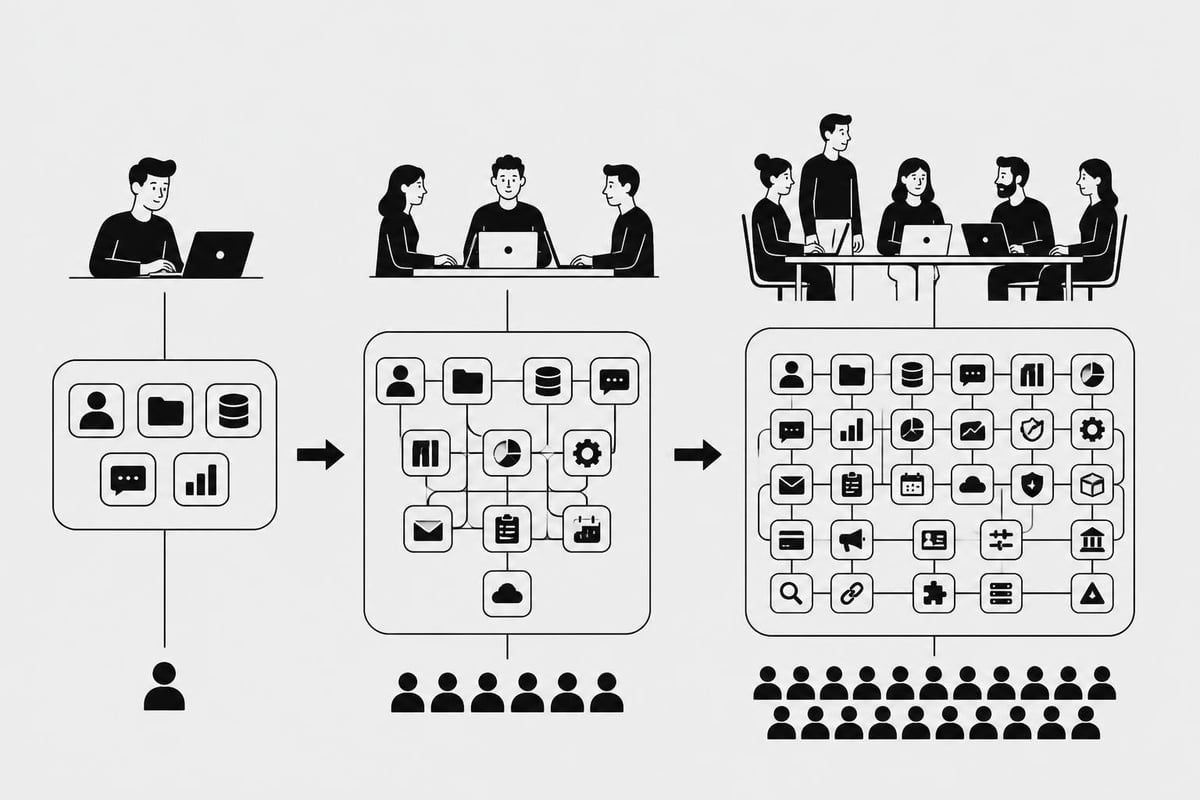
The optimal sales tech stack configuration varies dramatically based on team size, deal complexity, and available resources. A five-person startup requires fundamentally different infrastructure than a 200-rep enterprise sales organization.
Startup and Small Team Essentials
Organizations with fewer than 10 sales reps should prioritize simplicity and core functionality over comprehensive feature sets. The goal is establishing solid foundations without overwhelming limited teams with complex systems.
Minimum viable sales tech stack components:
CRM with strong mobile capabilities (Salesforce, HubSpot, Pipedrive)
Email engagement tracking (built into most CRMs)
Meeting scheduler (Calendly, Chili Piper)
E-signature platform (DocuSign, PandaDoc)
Video conferencing (Zoom, Google Meet)
This lean approach keeps license costs manageable while ensuring reps have tools for essential activities. Essential sales tech stack components for startups emphasize starting with proven tools that offer room to grow rather than enterprise platforms with capabilities you won't use for years.
Mid-Market and Enterprise Considerations
As sales organizations scale beyond 25-30 reps, additional layers become necessary to maintain coordination and visibility. The challenge shifts from basic functionality to sophisticated orchestration across multiple teams and geographies.
Larger teams benefit from:
Revenue intelligence platforms that analyze conversation patterns and coach reps in real-time
Sales enablement systems that organize content and ensure reps use current materials
Territory and quota management tools that optimize account assignment
Advanced analytics and BI platforms that slice pipeline data across multiple dimensions
Channel partner portals for organizations selling through indirect channels
The expansion from startup to enterprise sales tech stack shouldn't happen all at once. Highspot emphasizes the importance of staged rollouts that allow teams to adopt new tools gradually while maintaining productivity.
Integration Architecture and Data Flow
The technical foundation supporting your sales tech stack determines whether it functions as a unified system or a collection of disconnected tools. Thoughtful integration architecture ensures data flows smoothly between platforms without manual intervention.
Building a Single Source of Truth
Data conflicts emerge when multiple systems claim to hold the authoritative version of customer information. Establishing your CRM as the definitive record for customer data prevents confusion and ensures everyone works from the same facts.
Key architectural principles include:
All customer-facing tools write back to the CRM
The CRM serves as the master record for account and contact data
Other systems pull reference data from the CRM rather than maintaining separate copies
Clear data ownership rules prevent tools from overwriting each other
This hub-and-spoke model positions your CRM at the center with other tools connecting through APIs. While simple in concept, implementation requires careful planning around field mapping, sync frequency, and conflict resolution rules.
API Strategy and Middleware Considerations
Direct API connections between tools provide the most reliable integration but require technical resources to build and maintain. For organizations without dedicated integration engineers, several approaches exist:
Integration Method | Best For | Limitations |
|---|---|---|
Native integrations | Standard use cases | Limited customization |
iPaaS platforms (Zapier, Workato) | Non-technical teams | Can become expensive at scale |
Custom API development | Unique requirements | Requires developer resources |
Embedded integration (Merge, Paragon) | Product companies | Not applicable for end users |
Revenue Grid explores how modern integration platforms have made sophisticated data flows accessible to teams without extensive technical expertise. The tradeoff involves less flexibility compared to custom-built integrations.
Measuring Sales Tech Stack Performance
Technology investments should drive measurable improvements in sales outcomes. Establishing clear metrics helps justify ongoing costs and identify underperforming tools that should be replaced.
Adoption and Utilization Metrics
The most sophisticated tool delivers zero value if reps don't use it. Track adoption rates to ensure technology investments translate into changed behavior:
Daily active users as a percentage of total licenses
Feature utilization rates within each platform
Time spent in each tool (balance between too little and excessive)
Mobile usage rates for field sales tools
Compliance with required activities (CRM logging, call recording)
Low adoption often signals poor training, unclear value proposition, or fundamental misalignment between the tool's design and your team's workflow. Before adding new capabilities, ensure existing tools are being used effectively.
Business Impact Measurements
Ultimately, your sales tech stack exists to improve revenue outcomes. Connect technology investments to business metrics that matter:
Conversion rate improvements at each funnel stage:
Contact-to-meeting conversion rates
Meeting-to-opportunity conversion rates
Opportunity-to-closed-won rates
Average deal size changes
Sales cycle length reduction
Compare these metrics before and after tool implementations to calculate actual ROI. Many organizations discover that choosing the right CRM for your team size matters less than how thoroughly they implement and optimize whatever platform they select.
Emerging Trends Shaping Sales Technology in 2026
The sales technology landscape continues evolving rapidly as new capabilities emerge and buying behaviors shift. Understanding current trends helps future-proof your technology investments.
Consolidation of Point Solutions
After years of expansion, the market is shifting toward platforms that combine multiple capabilities rather than specialized point solutions. This consolidation addresses tool sprawl while reducing integration complexity.
Vendors now bundle features that previously required separate tools:
CRM platforms adding native engagement and enablement features
Engagement tools incorporating meeting intelligence and coaching
Revenue intelligence platforms expanding into forecasting and planning
Data providers offering integrated prospecting and enrichment
This trend favors organizations willing to accept 80% solutions across multiple functions over maintaining a collection of best-of-breed specialists. The productivity gained through unified interfaces and integrated data often outweighs missing edge-case features.
Conversation Intelligence and Real-Time Guidance
AI-powered conversation analysis has moved from nice-to-have to table-stakes for competitive sales organizations. These systems transcribe calls, identify key moments, surface objections, and provide real-time guidance to reps during customer interactions.
The 2026 generation of conversation intelligence tools goes beyond post-call analysis to deliver:
Live battle cards during discovery calls based on detected pain points
Automated follow-up email drafting using conversation context
Competitor mention alerts that trigger specific positioning guidance
Sentiment analysis that helps reps recognize buying signals or disengagement
Revenue.io defines how these intelligence capabilities are becoming core components of modern sales stacks rather than optional add-ons. Organizations that delay adoption risk falling behind competitors who leverage AI coaching at scale.
Avoiding the Customization Trap
Most sales platforms offer extensive customization options designed to accommodate unique business requirements. However, excessive customization creates technical debt and upgrade challenges that compound over time.
When to Customize vs. Adapt
The decision to customize a platform should balance the value of perfectly matched functionality against long-term maintenance costs. Each custom field, workflow, or integration point requires ongoing support as platforms evolve.
Customize when:
Your sales process provides competitive differentiation
Standard fields can't capture critical deal information
Regulatory or compliance requirements demand specific workflows
Integration with proprietary systems requires custom development
Adapt your process when:
The platform's standard approach represents industry best practices
Customization would prevent future upgrades or feature adoption
The difference is cosmetic rather than functional
You lack resources to maintain complex customizations long-term
Reprise advocates for a minimalist approach that favors platform standards over extensive modification. This philosophy reduces ongoing maintenance while allowing faster adoption of new vendor-provided capabilities.
Managing Tech Stack Evolution and Change
Sales technology rarely remains static. New tools emerge, existing platforms sunset features, and business requirements shift. Managing this evolution without disrupting sales productivity requires deliberate change management.
Scheduled Tool Evaluations
Rather than reactive tool additions whenever someone encounters a limitation, establish a regular cadence for technology assessment. Quarterly reviews allow strategic evaluation of:
Utilization rates and adoption metrics for existing tools
Emerging vendor capabilities that might consolidate multiple tools
Contract renewal dates and negotiation opportunities
Gaps in current infrastructure based on recent sales challenges
This structured approach prevents the ad-hoc sprawl that occurs when individual reps or managers independently purchase tools to solve immediate problems. It also creates opportunities to leverage vendor competition during renewal negotiations.
Phased Rollout Methodology
Introducing new tools across an entire sales organization simultaneously maximizes disruption while minimizing feedback opportunities. Staged rollouts reduce risk and improve outcomes:
Pilot phase: Deploy to 3-5 reps representing different experience levels
Feedback integration: Refine configuration based on pilot learnings
Early adopter expansion: Roll out to enthusiastic team members who will champion the tool
Broad deployment: Expand to remaining team with trained champions available for support
Optimization: Continuously refine based on usage data and feedback
This methodology, outlined in frameworks for designing sales systems that scale, reduces the disruption and resistance that often accompany technology changes. It also surfaces integration issues or workflow conflicts before they impact the entire team.
Data Security and Compliance Considerations
Sales tech stacks handle sensitive customer information, making security and compliance critical considerations. Neglecting these areas exposes organizations to data breaches, regulatory penalties, and reputational damage.
Essential Security Requirements
Every tool in your sales tech stack should meet minimum security standards regardless of vendor size or tool category:
Encryption: Data encrypted both in transit and at rest
Authentication: Support for single sign-on (SSO) and multi-factor authentication (MFA)
Access controls: Role-based permissions that limit data exposure
Audit logging: Comprehensive tracking of who accessed what data when
Backup and recovery: Regular backups with tested restoration procedures
Smaller vendors sometimes lack enterprise-grade security practices. During tool evaluation, request SOC 2 reports, review security documentation, and understand how customer data is protected and where it's stored geographically.
Regulatory Compliance Across Jurisdictions
B2B sales organizations operating globally must navigate complex regulatory requirements including GDPR in Europe, CCPA in California, and various industry-specific regulations. Your sales tech stack must support compliance requirements:
Regulation | Key Requirements | Tech Stack Implications |
|---|---|---|
GDPR | Consent tracking, right to deletion | CRM must support data purging |
CCPA | Opt-out mechanisms, data disclosure | Tracking of California prospects |
HIPAA | Protected health information controls | Encryption and access logging |
SOX | Financial record integrity | Immutable audit trails |
TechTarget explores how compliance requirements increasingly drive technology architecture decisions, particularly for organizations selling into regulated industries. Building compliance capabilities after the fact proves far more difficult than designing them in from the start.
Building an effective sales tech stack requires balancing capability, integration, and usability while avoiding the trap of accumulating tools that create more work than value. The best technology infrastructure fades into the background, empowering reps to focus on customer relationships rather than system management. At erakraft inc., we help B2B sales teams cut through the complexity by building unified sales systems that consolidate your existing tools, eliminate redundancy, and layer in custom AI where it genuinely improves outcomes.